FINDING OUR FARRELLS
INTRODUCTION
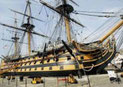
When my siblings, Sue, Nick, and I were youngsters, our father, Albert Peter William Farrell, used to say that one of our ancestors had supposedly been present at the death of Admiral Lord Nelson on HMS Victory, following the Battle of Trafalgar in 1805, but that was about all he knew of his Irish roots. When he retired, he and my mother Betty resolved to research the family in depth, being a very difficult task, given that many records in Ireland have been destroyed in various uprisings and accidents during the past 200+ years. They went to Dublin and pored over documents that had survived in libraries, churches, and municipal offices, but without success. Lots of Farrells, but nothing to tell them much more than they already knew, which was mainly about Dad’s grandfather, “Peter (Francis*) Farrell”.
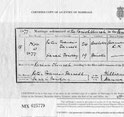
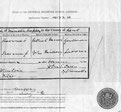
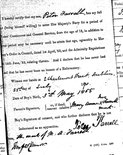
*At no time was Peter legally given a middle name and in fact as an after-thought, on a copy of his marriage certificate,, “Francis” was subsequently crossed out and initialled, presumably by him.
However, Dad’s Uncle Cecil helped out with a sketch of an ancestral tree based on his memory of family stories, headed by Peter’s father Patrick, alongside whom he noted - “Physician” and “Owned horses”. With the aid of Google and Ancestry.com I have attempted to continue our parents’ quest, with some success.
When Peter married, he gave his father’s (ie Patrick’s) occupation as being “Gentleman” (See marriage certificate), raising the question - “Surely Peter would have known that his father was a Doctor or Physician and have been proud to record same, not just the honorary title of Gentleman?” Therefore, could Cecil possibly have been confusing Patrick with another family member, who was in fact the “Physician” in the family?
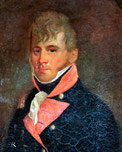
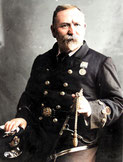
Cecil passed on a portrait (See photo) that he possessed, to his son Keith’s Canadian family, being of a gentleman in fine clothes, probably painted during the first half of the 19th Century. Apparently, they always believed it to be either a “Dublin Farrell” or a “Portsea Bendell”. (Bendell - Cecil’s wife Lilian’s maiden name.) Close examination reveals that the subject was wearing a dress uniform, with brass buttons and an epaulette on the right shoulder.
When epaulettes were introduced in the late 18th/early 19th century for Royal Navy officers, initially one on the left shoulder denoted that the wearer was a “Commander”, whilst later, one on the right shoulder was allowed for junior officers. Ultimately, they were worn on both shoulders, in varying designs according to rank.
PART 1 - JAMES FARRELL
In 1813 the British “Naval Chronicle” publication listed an Assistant Surgeon James Farrell as having been appointed to the Royal Navy’s Gun Brig “Furious”. The Furious was an 18-gun brig-sloop that was launched in 1807. She was involved in several actions during the Napoleonic Wars, including the Battle of Basque Roads in 1814. Then later that same year, on 9th October, James Farrell was promoted to full Surgeon. According to Bard and the Naval Chronicle, James Farrell (1782-1852) also served on the following ships: Eliza and Jane tender (1809); Trusty P. H. S. (1809); Vengeance prison-ship (1809); Belleisle (1811-1812); Africa (1812-1813); Barfleur (1813-1814); and Royal Sovereign (1814-1815).
COMMENT: If we accept that James was indeed born in 1782 and that he followed due process for those times, then by 1798, having gained the necessary schooling in Maths and Latin, he would have been apprenticed to a reputable Dublin surgeon for five years, making him eligible for the Navy by say 1803. With no experience he might have joined as a “Surgeon’s Mate” and after a few years became an Assistant Surgeon on “Eliza & Jane”, which plied between Dublin and Plymouth, thereafter achieving full Surgeon’s rank on the “Furious” in 1813. (From Rootsweb – RN Surgeons)
James could conceivably have served on HMS Victory at the Battle of Trafalgar in 1805 and as mentioned previously, I will always remember my father’s rare family story, to the effect that one of our ancestors had been ‘with’ Nelson when he died. But he could only think it was Captain Hardy and he used to have a good chortle at Nelson’s purported final words - “Kiss me Hardy”. Ancestry has revealed that Dad’s mother did have Hardys on her side of the family, but they were Surrey farm labourers, not good officer material! I only wish that Dad could have been here now to learn that conceivably a young surgeon’s mate named James Farrell, probably his Gt Gt Grandfather, was tending to the many other wounded on “Victory” that day.
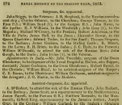
Quite whether “Royal Sovereign” was James’s last ship, we don’t know, but in the general demobilization following Waterloo he could well have been retired back to Kingstown and placed on the Navy’s reserve list. Anyway, in April 1821 James was appointed as Doctor to the massive Kingstown Harbour Project. A published report at the time can be seen right.
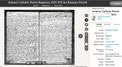
Then on 20th Feb 1824, James applied for a position on the prison hulk. See right from the National Archives of Ireland.
James stressed hope for advancement. Remarked that the remuneration of his current post as agent for sick and wounded seamen was “very limited”. From this record we further learn that James was still serving in 1816, being present at the “Bombardment of Algiers” and that his first year in the Navy must therefore have been 1800, as surmised previously.
*Ironically, had he obtained the position, a distant cousin named Thomas Farrell, convicted of pickpocketing, would have been in James’s care eight years later, when he was held on the Essex whilst Sydney bound!
Unfortunately, James did not succeed with his application, but things must have improved financially because between 1833 and 1847 Dublin Directories listed “James Farrell Esq. Surgeon and Accoucheur of George’s Street, Kingstown”, with “MD” (ie Physician) added towards the end of that period. Also listed from 1833 onwards was a “James Farrell Esq of Rose Cottage, Killiney”, a village about five km south of Kingstown and close to Cabinteely. Given that George’s Street was a business address, it is likely that James had his home on the coast in beautiful Killiney, along with many other members of Dublin’s “Gentry”.
An excellent website, “Killiney History”, provides maps that locate “Rose Cottage”, along with several other former Farrell residences, confirmed by Dublin directories, such as “John Farrell Esq of Ballinclay 1832-38”, “Luke Farrell Esq of Percy Lodge (Car owner) 1852-58”, “John Arthur Farrell Esq and Hon. Mrs Farrell of Beechwood 1869-1872”, together with “Joseph Farrell, Smith & Farrier, of Eagle Lodge 1834”, “Mr Michael Farrell of Mountain View, Mr Farrells Yard & Forge 1847”, and “Thomas Farrell of Percy Lodge 1847”. The Farrell’s Forge business receives many mentions, one of the Farrells apparently having lived to 106! Just if or how any of these Farrells might have been related to us there’s no telling but at least they would probably have been acquainted and the style in which the “Esquires” lived in those times leaves no doubt that they were in the “upper echelons”!
In 1837, James was recorded as being a regular subscriber to the Topographical Dictionary of Ireland along with John Farrell of Moynalty (Gormanston).
So far we have ascertained that Surgeon James Farrell Esq RN was a real person of some standing in the Kingstown, Dublin community during the period roughly 1820-47, but have nothing to connect him with our Farrells. Which brings me to a 5th- 8th cousin DNA match with a lady in Australia named Shaw, who has a 3x great grandmother, Martha Farrell, born Kingstown in 1829, daughter of a “James Farrell”, who died in 1852. Her mother “Elizabeth Sexton” had supposedly died about two years earlier. Martha emigrated to Australia alone soon after and found a husband in Queensland.
In accordance with DNA relationship guidelines, for Ms Shaw to be my 5th-8th cousin, with her 4x great grandfather being James Farrell, makes a strong case for James to be my 3x great grandfather, and of course for James to be father of Patrick*. In which case, the portrait is probably of James Farrell in Navy uniform, not of Patrick or William Bendell as previously thought. (*And Martha to be Patrick’s sister.)
Encouraged by the “Great Aunt Martha” connection, I reviewed several distant cousin matches whose trees claim “Farrells” born within James and Elizabeth’s likely years of child bearing marriage, say between 1805 and 1835, being potential siblings for Patrick and Martha. Possibilities include:
· Thomas Farrell 1805 – Daughter Catherine m. Ferry and emigrated to New York. (John Dixon)
· Michael Farrell 1811 – Descendants in Boston USA (Catiara Campbell)
· Mathew Farrell 1813 – Also Boston connections. (N.P.)
· Margaret Farrell 1815 – Descendants in New York. (Pam Murray)
· Hannah Farrell 1821 – Descendants in NSW and Victoria, Australia. (Jason Smith)
Together with:
· Patrick 1823 (say aged +/-20 on his marriage to Mary Ann (Marianna) Deering in 1842)
· Martha 1829 – Emigrated to Brisbane, Australia (Shaw)
In addition, another possible sibling for the above could be a “Bernard”, and/or an “Edward”, born some time in between, for reasons that will follow. That James and Elizabeth Farrell had at least seven children, probably more, is predicated upon the fact that most Irish Catholic families in those times were large, a child born nearly every year being quite normal, but of course in James’s case his absences at sea between 1803 and 1815 would have kept the numbers down somewhat.
PART 2 - PATRICK FARRELL
The earliest record of any type that we have for Patrick is that of his marriage to Marianna (Mary Ann) Deering at St Michan’s Catholic Church, Dublin North in 1842. St Michan’s was local to the Deering home, and lath making business run by the bride’s father Peter.
As good Irish Catholics, Patrick and Marianne would have been expected to produce children at an average rate of one every two or so years, of whom say 50-60% could have been expected to survive infancy. But the earliest birth record we have is for 1854 with the parish register for St Michaels, Kingstown, Dun Laoghaire, Dublin telling us that on 26 February Roseanna, daughter of “Patt and Mary Farrell”, residents of nearby Cabinteely, was baptised there. For the record, Cabinteely is roughly two kilometres from Killiney where James probably lived!
The question remains, therefore, why does Roseanna appear to have been their eldest child? Were there no other births in between? Or if there were, did none survive? Cecil Farrell believed that his father Peter, who was born a year after Roseanna, had two older brothers, Patrick and John, who had emigrated to the United States, the latter having joined the US Army and become an “officer”. However, as will be revealed later, John founded a large branch of Farrells in the USA and evidence suggests that he was more likely to have been a first cousin of Peter’s, son of another of his father’s brothers, say “Bernard”. (This supposition is based on an Irish naming tradition, whereby a first son is named after the father’s father)
Next year, in 1855, Peter’s birth and baptism on 3rd May was recorded at St Mary’s Pro-Cathedral, Marlborough St., Dublin, his home address given as “Cumberland Street”. Getting one’s child registered at the cathedral was something of a status symbol and people came from far and wide for that purpose. Initially I assumed that the address meant “Cumberland St North, or South” in the city, but Kingstown also had a street of that name. Three years later, Joanna’s birth in the same street was also recorded at St Mary’s.
The question is, what did Patrick Farrell do to occupy his time in Kingstown, other than be a “Gentleman”? Did he help his father James, or was he perhaps the “Horse Owner” that our Uncle Cecil remembered? Did he perhaps use family connections to meet the demands for horses from all forms of transport in those days, or perhaps from the racing industry? Prominent Farrells in Dublin were three successful coach proprietors, livery stables operators and undertakers, respectively named Peter, Robert and William Farrell.
By 1853, according to street directories, an attractive house in newly developed Northumberland Ave. Kingstown, “Rossmore Cottage”, was occupied by a “Patrick Farrell Esq”. The house is still there today and it is interesting that a map of the 1830s development shows the house as originally having had a large area of ground to the side and rear, where horses undoubtedly could once have been kept. We cannot be certain that this was our Patrick but a strange twist to our tale follows.
Returning to the subject of young Peter’s marriage 7 years later at Sheerness in Kent, south east England, we meet 18 year old Sarah Friday, daughter of a farm labourer, our great grandmother to be. 22-year-old Peter, by then a “Seaman”, was stationed in the area, and given the relative strictness that applied to the conduct of young girls in those days, they had probably met in a formal environment, such as at church on a Sunday. Now, according to our late mother, Betty, a family story had it that Sarah was a member of the “Plymouth Brethren”, an organisation that actually originated in Dublin, Ireland where the first meeting of likeminded people, who felt that the Anglican church wasn't strict enough with its interpretation of the Bible, took place in 1825. It was only in 1831 that it became established in England. But let’s get back to Northumberland Avenue, Kingstown, Dublin.
One Brethren disciple, for want of a better characterisation, was a fellow called Joseph Denham Smith from Newry in Northern Ireland, who in 1848 moved to Kingstown, Dublin, with the intention of expanding Brethren membership in that area. He decided to raise funds and build a church, which he must have completed in the early 1860s, on land immediately neighbouring Rossmore Cottage in Northumberland Avenue. The building was likely small and very basic, but by 1913 a larger structure designed by architect George Beater had been completed, which today is known as Northumberland Hall, being No. 13 on the map. Behind the “Hall” is a smaller building, No. 12B, which was recently sold without anyone knowing what its origins were. Like as not, this was probably Denham Smith’s first construction, although the existence of a No. 12A set further back could also have been of significance.
It follows, therefore, that if young Peter spent some of his formative years, say 1864-70, living next door to a Brethren meeting place, he might well have become a member, or at least been influenced by the people who would have been there frequently, all contrary to his Catholic faith of course. Furthermore, it could explain how he eventually met Sarah, perhaps at her Brethren church in Sheppey. Ironically, at the time, headquarters for the Brethren in England was the city of Plymouth, Devon itself, where Peter went direct from Dublin following his Naval signing-on!
Patrick Farrell of Rossmore Cottage, Kingstown died on 11th September 1870, less than 2 months after 15 year old Peter was taken by his mother to join the Royal Navy. Patrick’s Will took 25 years to complete probate, indicative of there having been many complications to reconcile, much as might be expected with a deceased estate that had many creditors to settle with and no money to do so.
So there we have our Great, Great, Grandfather Patrick Farrell, still a bit of a mystery, but my gut feeling is that his father was in fact James the Surgeon who, although ranking highly in society due to his profession, was never particularly wealthy, as evidenced by the fact that he applied to become Surgeon for the convict hulk “Essex”, moored in Kingstown Harbour, “on the grounds that his other income was insufficient”.
Patrick possibly took maximum advantage of his father’s status to also use the title “Gentleman”, but without much money to support himself and a venture into horse rearing or dealing was necessary. Then, when the writing on the wall was clear that the “age of the horse” was nearly over, and Patrick got terminally sick, everything collapsed and young Peter’s future had to be taken care of, being another story altogether.
PART 3 – DNA MATCHING
Gathering information about Patrick Farrell to date has come up with some interesting possibilities but nothing that can be “cast in concrete” so to speak. I will return to Peter, in a later chapter, but meantime I want to briefly describe, in over simplified terms, how getting my DNA tested led to identifying hundreds of new Farrell cousins spread all over the world, some quite close, others distant, traceable either back to Patrick’s immediate family, or perhaps to his siblings. However, many people are deeply suspicious of the efficacy of DNA testing, some on religious or moral grounds, others because they just cannot believe the results. In fact, there are levels of reliability, best described by the following examples.
When Ancestry.com processed my saliva sample and fed my readings into the system, I was immediately informed of all my 1200+ DNA matches, ranging from (say) strong (2nd-3rd cousins - 250cM 4% shared DNA); to medium (4th-6th cousins - 55cM 1%); to weak (5th-8th cousins – 15cM 0.5%). I didn’t need DNA data to immediately recognise that the absolute strongest match, was a Canadian 2nd cousin whose family I visited 50 years ago and had not been in contact with since, being a grandson of the late Cecil Farrell, son of Peter. Others in the same category for my mother’s ancestors were also easily confirmed and my trust in DNA matching was established!
The strongest of the 4th-6th cousin readings, Julie, was unknown to me at first, but on making contact we discovered that we were probably related through a “John Farrell” who had emigrated to the USA, with the result that there are dozens of Farrell DNA matches in Iowa and surrounding States, as well as California. Some can be confirmed as Farrell descendants by reference to their trees, others not so easily, including, for example, people resulting from sperm donor births, of whom there appear to have been several, two confirmed.
The 5th-8th cousin category is basically unreliable and some results have no connections whatsoever, but there are others who have proved to be very distant cousins, usually by virtue of their matches with provable 4th-6th cousins. But even without such matches, many a 5th-8th cousin with the name “Farrell” appearing in their tree, has turned out to be for real.
Suffice to conclude, in addition to Ireland and the UK, I have many distant Farrell cousins in branches throughout North America and Australia, as well as a few in other parts of the world, some with DNA matches close enough to link them originally to Patrick Farrell, others more likely to have stemmed from one of Patrick’s siblings, or Uncles, as described.
PART 4 - PETER “Francis” FARRELL
When a homesick and frightened 15 year old Peter arrived in Devonport, he was signed on to HMS Impregnable, a training ship moored in the Hamoaze, a stretch of the River Tamar. Fifty-nine years before, Impregnable was in action at Algiers and Peter’s grandfather may well have been aboard! Anyway, between 6th August 1870 and 21st November 1871 Peter was also listed as a crew member of HMS Lord Clyde. In reality he probably resided on Impregnable along with hundreds of other boys, but had regular duties to perform on the Lord Clyde, which was moored close by. The wooden broadside ironclad was in the reserve fleet and undergoing engine replacement at Devonport Dockyard.
On 14 September 1871 Captain John Bythesea VC re-commissioned the Lord Clyde and sailed out to join the Mediterranean Fleet, presumably with Peter on board. Records also show that from the 21st November 1871, Peter must have been transferred to HMS Lord Warden, a warship of the same class, also based in the Med., probably in Malta, where he remained until 31st December 1872. The 1871 census would seem to contradict these facts, because Peter was listed as being resident, along with a long list of other young boys, at ‘Vessels, Devon’. However, it is probable that the Navy did not have to identify the exact whereabouts of all its personnel for census purposes, only their home bases.
Peter Farrell’s life as a youngster in the Navy was doubtless a hard and lonely one, although he was serving alongside many others with similar backgrounds and experiences. No doubt a spirit of camaraderie developed in the face of mutual adversity, but to all intents and purposes Peter became an orphan and there is no reason to believe that he ever went home to Dublin. However, the period between leaving HMS Lord Warden at the end of 1872 and signing up for his first 10 year stint in May 1873, which amounted to 4 months, might have been granted as long leave, if any family remained in Dublin to be visited.
From 1853, all boys from the ages of 14-17 joining the navy had to sign an engagement to serve until reaching 18 and then another 10 years, until the age of 28. Thereafter they faced the possibility of serving further engagements, contributing towards the 20 years required for a long service pension. When he reached his 18th birthday on 3rd May 1873, Peter signed up for the requisite 10 years and at some stage during that period he must have been based either at the Chatham Navy Base, or at the Sheppey Coastguard Station, because on 10th November 1877, at Sheerness, Kent, he married a lady named Sarah Friday, born March 1859, of near-by Minster. The birth of their first son, Peter John followed shortly thereafter.
By 1881 the family was living at 11 Buckingham St., Portsea, an area of Portsmouth, with Peter serving as an Able Seaman on HMS Minotaur, an armoured frigate. By 1883, when Peter signed up for yet another 10 years, he appears to have been involved with the Coastguards, as a Boatman, at Fishersgate, West Sussex, between Worthing and Brighton. Two children were born at Southwick, in the mid 1880s, also in that area. By 1888, when Herbert Peter Farrell was born, a move had been made to West Wittering Coastguard Station, just to the east of Portsmouth.
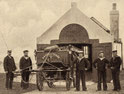
Sometime between 1891 and 1901, Peter was transferred again, with a promotion as Chief Officer, to the Lepe Coastguard station, on the New Forest shore of the Solent, opposite the Isle of Wight. There the family lived in the 'Officer's House' (see photo), one of a terrace of Coastguard cottages that still stand today. Peter's third 10 year signing expired in 1903, but he signed on for another seven years at Langley, and Bexhill, both in Sussex. In 1910 he retired and was back living at Copnor, in Portsmouth, seemingly working in “civvy” life as a Ships Rigger.
Sadly, Peter John, their first born, had lived for only 2-3 years, but 6 more children had followed, Sarah (1881), Phillip (1883), William (1885), Herbert Peter (1888), Cecil (1890), and Guy (1901).
Notably, Phillip became a Sergeant Major in the Army during WWI, fought in the trenches, married a French girl, Paulette, but died soon after the war, in 1920, from the effects of shell-shock, leaving his wife, and a baby daughter, Eliane. I got to know Eliane Anger and her son “Michel” when they visited our Marchwood family circa 1953.
William joined the Navy as a gunner, worked his way up to Lieutenant, fought in and survived WWI, only to die tragically in 1918, whilst in Italy, a victim of the great Flu Epidemic.
Guy and Cecil also joined the Navy. Cecil became an ERA (Engine Room Artificer) and following retirement from the navy he worked for many years at Cammell Laird, Shipbuilders, on Merseyside in the north-west of England, where I was able to get to know him and wife Lilian well. Which leaves just Herbert Peter Farrell, my grandfather-to-be, about whom more is to come. Peter and Sarah Farrell eventually left Portsmouth and retired to live in Kent, at 78 Grosvenor Rd, Belvedere. Peter died at Guys Hospital on 3rd July 1930, aged 75. Sarah lived on for another 10 years, passing away in 1940, aged 81.
PART 5 - HERBERT PETER FARRELL (“Bert”)
To set the scene for “Bert’s” life story, we need to return to Lepe, Hampshire, where Chief Officer Peter Farrell and his family were based between 1899 and 1903. Also based there at the time was Coastguard Albert Brewser and family, including a daughter Margaret Jane, who was three years younger than Bert. They were “sweethearts”.
Bert joined the Navy and served as an Able Seaman/Petty Officer/Baker on seven ships, from 1903 to 1907, including HMS Calliope and HMS Ganges. Like his father, Bert seemed set to make it his career, but as his Navy record states, in 1907 he was discharged, “Shore by purchase”. The family story has it that father Peter paid. Meantime, however, as the family story also goes, at a very young age, Margaret, or “Maggie” as Bert called her, had gone into service, at “Lumley Castle”, home of the Scarborough family in faraway County Durham. Here I quote my mother, Betty Farrell, from a letter written circa 1992.
“The Duke of Scarborough’s daughter lived at Exbury House near Lepe and recruited Maggie as an “Under-Nursemaid” on behalf of her mother, Lady Scarborough. They liked to employ country girls, no matter how far they were from their homes*. At the Castle, a frightening, cold place, built in the 1300s, Maggie cared for the infant Alice Montagu Douglas Scott, future Duchess of Gloucester. But she fell pregnant by someone unknown and was sent home. “Goings-on” amongst the Aristocracy in those times, led by King Edward VII, were widespread”.
*Presumably locally employed girls would be inclined to tell their communities all about those “goings-on” and cause a few problems, particularly if “invited to participate” in any shenanigans!
When he heard about it, Bert decided that he would marry Maggie anyway and she gave birth to a girl shortly after their wedding, in May 1909. Meantime he had signed up in the Merchant Navy, possibly as a Baker, on ocean liners sailing out of Southampton. A number of transatlantic crossings followed until in 1912 he was told to report for duty on the prestigious new liner “SS Titanic” that was preparing for its maiden voyage to New York, but great disappointment in the family followed when just before the sailing date he was reassigned to another White Star Line vessel!
In the 1920s Bert skippered a private yacht that a wealthy businessman kept moored on Southampton Water but having bought a house and land in Marchwood he found employment as a “Skilled Labourer” in the local Royal Naval Armaments Depot. When WW2 commenced the depot frequently became a target for German bombers. His home, “Calliope”, 1 Magazine Lane, was quite close to the Depot and one night, following a direct hit, Bert escaped by diving into a ditch and with a sheet of corrugated iron for protection from the exploding ammunition, he crawled along the ditch and found his way home, unscathed! Next day he cycled over to our house in nearby Totton to tell us that he had survived! Bert died, aged 68, in 1954 when cycling home for his lunch. “Calliope” remains today, the land having been sold off to become a housing estate, known as “Farrell Fields”, in memory of the family!
Bert and Maggie had a daughter Ethel and three sons, Peter, Patrick (Pat) and Edward (Ted). Pat was a Coldstream Guard in WW2, worked at Marchwood Power Station from commissioning to demolition and remained a bachelor. Ted was a Royal Marine Commando in WW2, married a Nursing Sister, Valerie, from Exeter, and worked at Fawley Refinery for the rest of his time. Peter, my father, was a good all-round sportsman and choir boy, married Betty of the Windsor Cleaves, got bombed out of his job at Vesty’s Cold Store in Southampton Docks, transferred to their Reading Store and became a Home Guard ‘ack-ack’ gunner for the rest of WW2. Subsequently moved with the family to Falmouth, Cornwall as Management Secretary for Silley Cox & Company’s Docks and Ship Repair Yard. Betty and Peter had three children, myself, Suzanna, and Nicholas.
PART 6 - JOHN FARRELL
If you are familiar with the term “like looking for a needle in a haystack” then you will understand why I often use it to refer to our search for the 19th century Uncle or Cousin John who belonged to the Dublin branch of our family tree. As mentioned previously, my Great Uncle Cecil believed that there were two brothers, Patrick and John, both of whom emigrated from Ireland to the USA. Nobody knew what had ultimately happened to them, but John was said to have joined the Army and become a “Captain”.
When I received my DNA matches I found that I had two people whose family trees contained “John Farrells”. One was with a lady whose great grandmother had been a “Nell Farrell” of Bowling Green, Missouri, whose father, as I subsequently discovered, was a ”John Farrell”, born 1845, in Ireland. The other, a lady named Julie, resident in the State of Iowa had a comprehensive Tree containing many Farrell branches and a supposedly Dublin-born “John Farrell” at its head.
The Nell Farrell connection was of particular and immediate interest because her father had served in the Union Army during the American Civil War, which was just possible for someone born as late as 1846. Anyway, on Sept. 11th 1862 a John Farrell, recorded as being aged 21, enlisted in the Union Army at a place called Castleton, New York, mustered in as a Corporal. Most Irish immigrants to the USA during years prior to Ellis Island’s opening in 1892 were processed at Castle Clinton and during the Civil War, Union Army recruiting staff used to meet new arrivals and with promises of immediate pay, accommodation, meals and clothing, many of the young single men were happy to accompany their benefactors to an army base and sign on for war service. 17-year-old John could well have been one of those recruits and if he was officially too young, a nod and a wink would have encouraged him to lie about his age, as most definitely happened with many arrivals.
Following training he joined K company of the 156th Infantry Regiment on Nov. 13th and was promoted Sergeant on Nov. 25th 1862. ‘Sergeant’ was ‘Non-Commissioned Officer’ rank (NCO). Why would a young recruit make Corporal and Sergeant so quickly? Well, probably because his education had been significantly better than that received by his fellow recruits and he was urgently needed for administrative duties such as in the Quartermaster’s Department.
The 156th ranged wide, down to New Orleans and Baton Rouge, then up to Virginia, where on Oct. 19th 1864 John Farrell was wounded at the Battle of Cedar Creek and taken prisoner by the Confederate Army. Eventually he was paroled and mustered out on July 29th 1865. In all probability John was kept initially as a POW at the Andersonville facility in Georgia, but once released on parole, he would have gone on to a Union Army parole camp to sit out the war.
When John demobilised, then like many others he needed a job and to a certain extent the government tried to look after its veterans. From government records it seems that John was hired by the US Post and employed at one or more New York post offices, in order to learn the business and work his way up. Then In 1873 the US Register of Civil, Military & Naval Service – Post Office, listed a John Farrell as Postmaster of the Frankford Post Office, Pike County, Missouri, receiving a salary of $180.00.
According to the 1870 US census, a Miss Mary Rebecca McCune (Mollie) was born in 1852 at Cuivre, Pike County, parents being farmer Joe & Mary McCune. Mollie was the eldest of ten children. Frankford is approx. 24 miles from Cuivre and John obviously met Mollie, because in Pike, on 29 June 1876 (According to Missouri records) they were married, Mollie being recorded as ‘Miss Mollie Melone’! A son, Edward*, was seemingly born soon after, suggesting that the marriage was out of necessity, and co-habitation may not have taken place thereafter, because seven years were to elapse before Mollie had another child! (*Irish naming tradition could indicate that as a first-born son Edward was named after his Grandfather).
The June 1880 census had the family (John, Mollie & Eddie) living on Main Street, Bowling Green, John’s occupation supposedly being that of “Editor, Post Observer”, a local newspaper. State Records of that time acknowledge the Observer’s registration as a weekly newspaper, but officially questioned whether any distribution actually took place or was sustained throughout the late 1870s/early 1880s.
So, from 1876 onwards it would seem that John possibly had issues to contend with around his marriage; lost his secure job with the US government; and was the “Editor” (Elsewhere registered as the publisher) of a newspaper that mostly existed in name only! If he was having problems, we might ask, why so? A hypothetical question of course, but for many Civil War Vets the answer would be the same – Post Traumatic Stress Disorders (PSTD) and/or alcohol.
John Farrell’s Iowan descendants have no hard evidence whatsoever of his life before he appeared in the Clarinda, IOWA area in the mid-1870s. They only know what he told his wife and her family during the three or so years that they co-existed before he disappeared, at least to all intents and purposes, off the face of the earth. It was left to his son, Bernard, to pass on such stories as his mother or uncles might have told him, stories that would have been heavily coloured by the acrimonious ending of a short-lived marriage.
And, of course, old family stories passed down from generation to generation by word of mouth can change over time in many ways. For example, details may be lost or forgotten; a story may be embellished or exaggerated; or it might be interpreted differently by different people. The problem therefore, as always, is which of such stories should be treated with grains of salt and which, conversely, carry the ring of truth? Commendably, it would seem that our cousins in IOWA have retained an open-minded approach to their stories and here are some examples.
When I first made contact with Cousin Julie she told me that she had joined Ancestry with one goal, namely to find John Farrell, her great great grandfather. Unfortunately, she had not, “he was in the wind. Something happened between him and his wife, I don't know what, just handed down stories saying he went back to Ireland, that he went back to fight, supposedly in the Easter uprising”.
“In the wind” was a very apt expression of Julie’s, because following John’s arrival in the area, he must have met Rosa Belle Clark circa 1879, married her in July 1880, conceived a child in March 1881 (Bernard born Nov 81. Perhaps named after a relative back in Ireland?), had a falling out sometime thereafter and seemingly dropped out of sight towards the end of 1882, having written two letters to Rosa from Burlington, and Maryville, Missouri dated 13th and 14th September respectively. John is believed by the family to have been 27 years old at the time of his marriage, but no actual record has been found.
Julie went on to say that “Rosa Belle did a good job at making John hard to find. She told stories I believe to have been a subterfuge (i.e. To prevent people from finding John). Using her second husband’s date of birth for John’s, the same with his place of birth. Everyone has been told he went back to Ireland, or to New York. John’s son Bernard has been quoted as saying he always looked for his Dad in a crowd, but how would he have recognized him, since no pictures of John have surfaced. I have been told that Rosa allowed John to see his child once”.
Although Julie makes clear that nothing exists to substantiate the stories, they reveal an interesting vein of possible truth, namely that John may have remained living within reasonable travelling distance of Clarinda for some time, possibly years. Otherwise, why would Rosa have needed to keep his whereabouts secret? But an even more interesting question is that if life continued for John and he was free to do so, then as a man in his thirties, the odds would have been heavily in favour of him having remarried and had more children, in which case our cousin’s efforts to trace him might have had results by now?
Getting back to Bernard, Julie had failed to find an actual birth record for him, but censuses over the decades always recorded ‘Iowa’ as his birth State, except one which said ‘Missouri’. Mistake? Not necessarily, because census takers could easily have assumed Iowa without asking, because he was living in Iowa, whilst the one actually asked him where he was born! So maybe Missouri was correct!
Rosa filed for divorce in November 1884. The court found that Rosa’s allegations were true and that she was entitled to the “relief prayed for”. The marriage was declared “dissolved, null and void and of no effect”. Custody of Bernard was given to Rosa Belle and within 4 months she was re-married, to a William Rash of Lucas County, originally from Kentucky. In effect she was granted an ‘annulment’, a legal term often used where one of the parties has committed bigamy. John was served the paperwork to appear but was a ‘no show’.
Going back to the beginning, when John first appeared, the family often speculate on why he chose the Lucas/Clarinda area of IOWA and how he got there. Apparently he talked a lot about New York, as if he had spent some time there before heading west. In the 1870s railroads and mining were big business and John could easily have been employed on one or the other. Coming from a good family background in Dublin he would have had at least a basic education and therefore would have been much in demand for clerical employment.
In wondering how John seemingly got into so much trouble, it is worthwhile considering what sort of a place Clarinda was mid-late 19th century. Founded in 1851, for the next thirty or so years the city had become a major centre of activity for the development of railroads in Iowa’s south. Eventually Clarinda became the junction for rail services from five different directions. By 1866 incorporation had been achieved and the city’s rapid growth was boosted by the significant numbers of construction workers needed, followed by the people required to operate services. As always happens in such circumstances, opportunities to earn good money attracted men from far and wide, some of whom brought their families with them, but as is usual with major construction projects, most were there on a single basis. In the early days, therefore, Clarinda had the character of a ‘Wild West’ town where there were two distinct areas, one known as ‘Up-Town’, the other as ‘Gun Town’, with railroad yards somewhere in the middle.
Typically Gun Town grew to have plenty of bars and brothels and no doubt the railroad work force provided most of the custom for both, keeping law enforcement officers busy, at least when they weren’t keeping an eye out for Jesse James, the infamous outlaw, who is said to have passed through Clarinda frequently between 1866 and 1882! Of course, many of the younger railroad workers found wives amongst the rapidly growing population and settled down to lead respectable lives, but no doubt a few went astray and Gun Town had its temptations!
But now we come to hard evidence of what was probably John and Rosa’s final meeting and of John’s movements thereafter and with it some very revealing pieces of information, all in the form of copies of two very personal letters written by John to Rosa Belle in September 1882. By then the couple had been married for just over two years and Bernard was only 10 months old.
The first letter was written at Burlington Junction, Missouri, a town roughly 23 miles due south of Clarinda, Iowa, connected by a railroad that had been operating since 1879. From the letter, which is not easy to read due to marks or stains, it would seem that John must have been with Rosa Belle the previous evening and either that night, or next morning, travelled down to Burlington on the railroad. I have transcribed the letter as best I can, but some words (left blank) are indecipherable.
Left – Example of “Johnny’s” letters. Right – About “Sharp”.
LETTER 1
Burlington, Missouri.
Sept 13th ‘82
Dear Wife, I come to my right mind just now But I am not going to ask you for to live with me for I know it would do no good. Now you will never be troubled with me again. I ment to do right last night But got left with beer if I am not killed I shall do it myself Before long you can get 2 Dollars that I gave for the shingles & seven to Walker & all is yours Poor Benny God keep him from drink Johnny
John then seems to have decided on writing a second page.
No one in Clarinda liked or cared a cent about me But I will come some night when they don’t look for me and I will ___ my life ___ ___ ___ ___ wanting there I hope you will do better by your next man I will see you when you wont see me look out for what I was dreaming about _ must come to pass _ believe I am ______(crazy?) Johnny
Clearly ‘Johnny’ was in a very troubled state when he wrote this letter, possibly being ‘in his cups’. The phrase ‘if I am not killed I shall do it myself’ could mean that his life was under threat from a third party for some reason and that if it did not happen he would commit suicide, or perhaps he was accepting that his drinking would ultimately finish him off? Another family story has it that Rosa’s brothers sent John ‘packing’ after some incident or other and by “they don’t look for me” perhaps he was referring to them. Mention of Rosa’s “next man” is interesting! Was her second husband already in the offing or was John simply accepting the inevitability of being replaced one day? The main question is why was he seemingly disliked by people in Clarinda? Was he some kind of ‘ne’er-do-well’ or was he simply the town drunk, in which case why did Rosa marry him in the first place, or did he turn to drink within a short space of time after he was married?
By the next day John had moved on to Maryville, a town only 16 miles from Burlington Junction, also on the railroad, where he wrote his second letter to Rosa, obviously in a better state of mind, or had he simply sobered up? This letter was easier to transcribe, with only a few words towards the end that have defeated me.
LETTER 2
Maryville, Missouri.
Sept 14th 82
Dear Wife
What on earth will I do all alone. I want you to forgive and say you will love me still. I am very sorry for what has been done & said. But Bell dear I was drunk & mad with someone I don’t know anything but now I am done with it for life write to me darling for god sake Oh I know I am very unhappy if you love our babby take his father to your hearth once again I am to young to dye & I will never be contented without you & my babby Don’t let anybody keep you from me but if you will live with me again I shall never drink a drop Remember Father Martin love God knows I did not get that way in my right mind do take care of our things I have got steady work here & a house to rent if you will live with me darling that will end such work People will say Don’t believe him But just try me once again I have taking the pledge against strong drink for ever Darling ____ ___ know what I did I only got sober now I cant stand it long Oh Belle don’t make a criminal of me like Sharpe Remember I am Benny’s Papa god help him Good Bye ___
John’s main thrust, of course, was an all-out appeal to Rosa for a reconciliation. Apparently they had previously been to see Father Martin, a priest in Conception, another railroad junction 38 miles south east of Maryville, for a marriage guidance session, which obviously hadn’t worked. His statement that “I have got steady work here and a house to rent etc”, could have meant that he had achieved that much in the few hours that he had been in Maryville (unlikely); or that in fact he had already been living there since breaking up with Rosa and had visited her in Clarinda during the previous few days; or that he was simply making it up to impress her.
That John’s drinking had been a major factor in his breakup with Rosa, is in little doubt, but his comparison of himself with ‘Sharpe’ reveals the “final straw” so to speak! “Otto Sharpe” was a man much in the headlines at the time, having been accused of murder in Missouri, but attracting equal attention was the fact that he had been exposed also as “The Much Married Murderer of Nodaway County”, to quote a Maryville newspaper! To the best of our knowledge, John was not involved in murder and he must therefore have been referring to his own case of bigamy!
Another aspect that stands out when considering the little amount of hard information that is available, must be John and Rosa’s other connections to that north-west corner of Missouri. We have “Missouri” as a possible birthplace for Bernard; a priest in Conception (East of Maryville) giving advice that would normally be given to parishioners; and Maryville being where John retreated to after his final meeting with his wife. On the off-chance that I might find other Farrell connections in the area I carried out a few searches, finding a Patrick Farrell, Farmer of Nodaway, who named a son “Johnny” in 1885; and the ancestor of a 4th-6th cousin, “Kimberly”, named “Inez Newcomer” who was born in Maryville, Nodaway MO on November 10th 1880, for whom I cannot find any other family connections. Pure musing, of course, but with Burlington, Maryville and Conception all being junctions for railroads built around that period, John may have been employed on a contract and the couple almost certainly lived there for a while, during which time Bernard was born.
So there we are. On the 14th September 1882 John Farrell was seemingly residing in Maryville. Then two months later, in Bowling Green MO, a day’s train ride to the east, John and Mollie Farrell conceived a son, “Forrest Sisson” Farrell, born August 1883 after a break of six to seven years since Eddie’s birth. “Nellie” Farrell followed in 1885 and “Henry Clark” Farrell in 1888. “Sisson” was Mollie’s mother’s maiden name, but no reason can be found for the use of “Clark” as Henry’s middle name! Then on 26th December 1892, John Farrell died “aged abt 50” according to Pike records.
Six years later, on 31st December 1898, Mollie filed for a Civil War Widow’s pension, John being recorded as having served in ‘Unkn N J Volunteers’ (ie Unknown New Jersey Volunteers)!
Forrest Farrell ultimately moved to Dallas, Texas, married and had a son, Joe T Farrell. Joe had a daughter, Linda Farrell, who married a Charles Mellen. I have a distant DNA match with a Linda Mellen!
In the course of researching John Farrell, I came across interesting details of the railroad developments that were taking place during the 1870s/1880s in the southern IOWA/North western Missouri regions.
Southern Iowa’s railroad boom got underway circa 1854, one of the earliest projects being one of the ‘Wabash’ railroads routed from St Louis MO via Conception, Maryville, Burlington Junction and Council Bluffs, through to Omaha. The Wabash was operational by 1879 and with the Clarinda to Burlington Junction Line also opening in 1879 it was possible to travel by rail from St Louis, Missouri to Clarinda, via Bowling Green, the latter less than 300 miles away!
Railroads were all the rage at that time throughout the USA and at the St Louis end of the Wabash system lines were shooting off in all directions. One such was called the ‘Shortline Railroad’ which had started construction in 1870, and on May 23, 1871 a company was formed in Bowling Green, Missouri to build the Pike County sections of that railroad, the route running close to Bowling Green and Frankford where John Farrell was to work in the Post Office. In fact the nearby stopping point was named McCune Station after Mollie’s grandfather John McCune, an early settler. In June of 1872 a construction company out of Iowa was hired to construct the Pike County sections but an economic depression caused construction to be suspended until 1875 when work recommenced.
By 1882 work was completed and the St. Louis to Hannibal became a reality. The rural area stops had cattle pens and loading chutes and trains stopped for all kinds of reasons, sometimes even for picking blackberries! Interestingly the engineer was a Frankford man named Lee Jackson (Snow) Stark.
Whilst researching John Farrell’s life in the Bowling Green area it didn’t occur to me that he might have been involved with railroads, but the fact is that between 1875 and 1882 there is no record of what he might have been up to other than the extremely doubtful editor’s role, and a “day job” as a travelling man, either with a contractor, or railroad company has to have been a possibility. Furthermore, although the 1880 census described him as being an editor, we don’t know for how long he held that position either side of that year. The job might not have been full time and indeed local records indicate doubt even as to whether publication was achieved regularly, or at all. Another possibility of course is that John worked in the new railroads postal service, which would have taken him away from home for extended periods.
So, was it our Uncle John who went to the USA when he was sixteen; landed in New York and signed up in the US Army; served as an NCO during the Civil War; worked in New York for the US Postal Service; transferred to Frankford, Missouri as Postmaster; married Mollie McCune just in time for ‘Eddie’ to be born; separated from Mollie and went to work on the railroads; met Rosa Belle Clark and married her illegally; had an alcohol problem; lived in Maryville where Bernard was born; got thrown out of his home by Rosa’s brothers when she found out about Mollie; went back to Bowling Green and was reconciled with Mollie; fathered three more children; named one of them Clark in memory of Rosa; and died at a relatively early age, perhaps of liver disease, or war wound complications? No, of course not, but what do you think? Either way, you’ve got to admit, it’s an interesting postulation, with at worst an amazing set of coincidences, not so?
PART 7 - PATRICK JOHN FARRELL aka PATRICINNE JOSEPH HOSHIE FARRELL
According to Ancestry.com, I have a DNA match with a Mr John Crossman of Bonita, California, USA, indicating that we are very distant (5th- 8th) cousins, possibly sharers of a 4x great grandfather. When first informed of this fact I checked his family tree and found that apparently John’s mother was a lady named Helen Greatsinger Farrell, who in turn was the daughter of a “Patricinne Joseph Hoshie Farrell (1863-1956)” and his wife “Edna Clare Greatsinger (1873-1958)”.
Normally, distant cousins are not worth following up, but when a family name also pops up, curiosity inevitably prevails and I decided to have a closer look at this possible family connection with the fancy name. I found plenty of detail in the Crossman tree about Patricinne’s life in America, with references also to his activities elsewhere in the world, but the usual paucity of information about any Irish roots. However, one aspect that stood out was his association with the US military and the fact that he had been fairly high ranking, at one stage having been a “Captain”.
As described earlier, my Irish ancestry stems from one of my great grandfathers, namely Peter Farrell, born in Dublin, who later used to tell members of his English family, that two brothers, or uncles, Patrick and John Farrell, had emigrated to the USA, the latter having joined the Army and become an officer, possibly a ‘Captain’, but all contact with him had thereafter been lost and his ultimate fate had never been determined. With a mystery like that in our family, I think I can be forgiven for having decided to take a really close look at Mr Crossman’s grandfather, Patrick John, aka Patricinne J H Farrell, but since then I sometimes wish that I hadn’t!
The ‘oldest’ Farrells in John Crossman’s tree are supposedly his 2x Great Grandfather, a ‘William Farrell’, born in St Michael, Dublin, in 1790 and his wife, Elizabeth, also born 1790 in Dublin, but with absolutely no supporting evidence. John goes on to suggest, with his tree, that William & Elizabeth Farrell had a son, Thomas, born 1812 in Limerick, the year of William’s supposed death, a fact that does not give much credence to the origins of either, given that Limerick and Dublin are at opposite ends of Ireland and that there is no evidence of their relationship. Either John has the wrong William, or the wrong Thomas, or both.
Such errors are not unusual in Irish family trees, due to the lack of accurate records; the commonality of Farrells with first names such as the aforementioned, and Patrick, James, John, Michael, Matthew, etc, in the large families that people had in those days, 10 children being quite normal! I have to mention also, that there is a propensity amongst amateur researchers to believe and use incorrect names, dates or locations appearing in other people’s Ancestry family trees, thereby compounding the errors. This story will therefore begin in Australia, where reliable records from the 19th century remain intact!
On the 30th June 1832, in Kingstown, Dublin, two hundred male prisoners from throughout Ireland were embarked on the Dunvegan Castle from the Essex hulk, an old sailing ship used as a gaol. Their crimes ranged from various forms of stealing and robbery to assault and murder. There were some very young boys on this voyage; James Murphy and Thomas Norton were only 11 years of age. Another two were 12 years old; seven were 13 years old; seven were 14 years old; eight were 15 years old; nine were 16 years old; and six were 17 years of age. Also on board was Convict No. 3563, Thomas Farrell, aged 20, “of freckled appearance”, sentenced to 7 years transportation for pickpocketing in Dublin. They sailed next day and arrived in Port Jackson, Sydney Harbour on 16 October, a voyage of 107 days, amazingly with no deaths recorded during the voyage! Following a short period in Sydney’s gaol, Thomas was assigned to a “Mary Raine” as a house carpenter, in Parramatta, which suggests that he had been trained, probably in Dublin. By 1837 a Convict muster recorded that a Thomas Farrell was employed by a Mr W Chington, in Shoalhaven, New South Wales, an area about 200 km south of Sydney, to the east of Goulborn.
In 1839 a 15-year-old Ellen Connell, one of 8 surviving Connell children from Limerick (1 of 9 had died at sea off Indonesia), arrived in Australia and on 8th January 1841 she married a newly freed convict, Thomas Farrell, in Goulborn. They settled in the Braidwood area of NSW and their first child, a daughter, Mary Anne, was born that same year. She married a James William Cook in 1865 at Queanbeyan. I have another 5th-8th cousin match, named Nigel Cook, with Braidwood connections, whose great grandmother must have been Mary Anne! (I also have other DNA matches, distant cousins, who have Braidwood ancestry!) This would seem to suggest that Thomas Farrell indeed could have been a member of our Farrell Clan and that his grandfather, unnamed, would be my 4x great grandfather Farrell.
Mary Ann gave birth to 4 children, Sarah (1865-1951); Eliza (1867-1867); James William (1869-1921); and Henry (1871-1871). Mary Ann died in 1871, which suggests that she sadly succumbed as a result of the latter’s birth. Meanwhile, like good Catholics, Thomas and Ellen had continued to procreate, namely Elizabeth (1842-1919); William (1843-1911) (?); James (1845-1911); Thomas (1846-1906); Michael (1847-1870) (?); Ellen (1851-1938); Catherine (1853-1943); Isabella (1854-1921) (?); Margaret Maria (1858-1860); Margaret Bridget Gertrude (1860-1934); Farrell (1863); Mary Jane (1866-1869)?; and John (1869-1939). Note: Names with question marks following are doubtful, but the biggest question hangs over the 1863 birth of an unnamed “Farrell” as it appears in official records, which according to cousin John Crossman was in fact a boy, “Patrick John”, although there doesn’t seem to be any evidence to back it up. That such a fundamental clerical error (i.e. omitting to record the first names of a birth registration) could have been overlooked by everyone involved is strange, but the only other possible reason could have been that the omission was deliberate, with dishonest intent, but surely not something that Thomas, an ex-con, would wish to get involved in?
Braidwood NSW
As the years rolled by, through the 1840s and 1850s, with an ever increasing number of mouths to feed, no doubt Thomas had to work hard at his trade, look out for new opportunities and establish a degree of respectability in the Braidwood community, not easy with his background. Unfortunately, Ellen’s brothers had taken to crime for a living as ‘bushrangers’ and had become outlaws, along with the infamous Clarke family. During the sixties, Thomas, together with four of his adult sons, was suspected of aiding and abetting the Connells with some of their misdeeds, the police even keeping a file on them! One of Ellen’s brothers, Patrick, died in a police shootout and was conveniently taken care of afterwards by Thomas in a new found capacity as Undertaker for Braidwood. Such was the environment into which Patrick John Farrell, hereinafter referred to as ‘Pat’, was supposedly born and raised!
Two of Pat’s Uncles
Pat’s closest sibling was Margaret Bridget Gertrude Farrell, nearly 3 years older than him, but most likely to have been his closest childhood companion. In fact, given the size of the family, Pat would not have received much attention from his parents and a strong bond with Margaret is likely to have formed. Oddly, the Farrell new-borns were usually given only one, or at the most 2 first names, yet Margaret had 3, including a most un-Irish Catholic name, Gertrude! Granted, she was no doubt called Margaret in memory of her recently deceased sister, Margaret Maria, but to have been the only member of the family with 3 first names still seems a little strange.
Anyway, time passed and in 1878, at the age of 18, Margaret married a Thomas F Byrnes and left home, leaving Pat, aged 15, to fend for himself, which most boys were expected to do anyway, in their early teens. Years later, in 1896 to be precise, in an interview with the San Francisco Call newspaper, Pat described how “he had served with distinction in the English Army, had taken part in a Zulu campaign (in South Africa) and had been severely wounded in a battle that took place around the same time that ‘Napoleon, the Prince Imperial’ died in a separate skirmish with Zulus”. Well, the Prince died on 1st June 1879 and the Battle of Ulundi took place on the following 4th July. There is no record of any Australian contingent having travelled to Zululand at that time, so we have to believe that young Pat travelled there alone, joined the British Army and fought the Zulus. It is certainly possible that at home in Braidwood, young Pat could have read about the troubles in Natal, somehow found his way to Durban; lied about his age and was signed on by the British in some capacity to fight the Zulus.
Meanwhile, back in Braidwood, successively for 3 years Margaret had produced four children, Margaret, Edwin, Thomas and Elizabeth, the latter being twins. Unfortunately, around that time (1881) their father Thomas Byrnes died, probably in an accident, given that his death was the subject of a Coroner’s inquiry. Then yet more tragedy the next year when Elizabeth also died. As the story goes, later that year Margaret decided to leave the Braidwood district and travel 3000km up to Port Douglas in Queensland, supposedly accompanied, according to 1934 newspaper items following her death, by Pat, where she took up residence with him. Seemingly she left young Edwin behind, probably with her in-laws in nearby Gunning, because he died there 30 years later, registered as a farmer. Young Margaret and Thomas either accompanied her or were sent for later.
There is no particular reason to doubt the 1934 reports, in which case Pat must have returned to Australia between 1880 and 1882, either direct to Braidwood, or conceivably first to Port Douglas for a period. Indeed, if the latter, he could well have persuaded her to join him in Queensland and start a new life, where opportunities abounded. After all, it was quite common in Australia for young women to go looking for husbands, hopefully wealthy ones! A history of Port Douglas tells us that the town had only been established in 1877 but was growing very quickly by the early ‘80s (it had 21 hotels at peak) when the Farrells arrived there, the reason for its rapid growth being “gold” and the rise of Queensland’s sugar cane industry!
Which leads us to the question – If Pat, at the age of 16, went to South Africa and fought the Zulus; then returned home in order to move his sister to Queensland whilst he was still only 19, how did this incredible young fellow finance everything?
Interestingly, as a contribution to his tree, John Crossman wrote “Unfortunately, Braidwood's bushranging episodes of the 1860s had caused thirteen people to lose their lives. Due to the intimate connection with the bushrangers, his Irish parents chose Patrick to rid the family of this stigma. Money was raised and Patrick was sent overseas to be educated. He eventually obtained medical degrees from Edinburgh and Vienna”.
One has to wonder from whom John got this story! Direct from his grandfather? Or from his mother perhaps? It is hard to believe that Thomas & Ellen, with the cloud that hung over them and in a continual struggle to raise their large family, were able to persuade ordinary members of their community to finance an overseas education.
However, a more likely explanation could be that young Pat’s travels were indeed financed by his father, but from ill-gotten gains that could not be spent in the community, and that gold entered the equation somewhere along the line, certainly vis-à-vis Port Douglas and maybe even before, with respect to South Africa. Pat’s earnings as a boy soldier in Zululand would not have been much, but perhaps enough to pay for travel elsewhere in that country, possibly from working in a gold field, where he earned enough to return home, and organise Margaret’s relocation to Queensland.
Whatever Pat was doing in Port Douglas, all changed in May 1884, when Margaret married a Native Police Inspector, Michael Portley, thereby relieving Pat of any responsibility for her and the children. Then early the next year General Charles Gordon was killed by Mahdi forces in the Sudan and a call went out from the New South Wales government for volunteers to join a military force being sent to help the British sort things out. Khartoum, the capital, had been besieged from March 1884 to late January 1885, by Mahdi forces trying to overthrow the country’s Egyptian rulers. The Mahdi succeeded and afterwards killed many members of the British forces who were defending the city, including their Commander, General Gordon. When the news reached Sydney in February it generated a great deal of anger and the NSW government offered assistance to the British in the form of an infantry battalion, an artillery battery, and a small field ambulance detachment.
On hearing the news, Pat no doubt set off immediately down to Sydney and on the strength of his experience against the Zulus, signing up probably wasn’t a problem! Subsequently, following some very basic training, on 3rd March 1885 the NSW contingent left Sydney and arrived at Suakin in the Red Sea on the 29th. There they were put under British command, attached to a brigade composed of Scots, Grenadier, and Coldstream Guards. However, no battles were fought, only a few casualties were suffered as a result of skirmishes and by mid-June 1885, after only 3 months away, the Australians were back in Sydney!
Australian government records show that only three members of the NSW expeditionary force were actually wounded in action, several others having died of sickness in the field of operations and during the return voyage. Pat had sustained a significant cut above the eye and was likely one of the three, because he was to spend the next 18 months at Sydney’s Liverpool Hospital. Having started as a tent hospital in the 1790s, it was established in a brick building on the banks of the Georges River in 1813, being run as a hospital for soldiers and convicts. In 1825, a larger stone building had been constructed using convict labour.
By the late 1800s, Liverpool Hospital also housed a Lunatic Asylum which might explain why Pat is supposed to have spent 18 months there, because even with medicine being fairly primitive in those days, 18 months would still have been an unnecessarily very long time to be recovering from his facial wound. Mental illness amongst members of the military as a result of their experiences has always been quite common, not just amongst those who have been in action, but also amongst members of medical services who have nursed the sick and wounded. The Australians who died of various diseases in Sudan and during the voyage back, would have done so in circumstances that would have been extremely traumatic for those attending to them. On the other hand, Pat might have been a member of the expeditionary force’s ambulance team, not a combatant at all, and simply have worked at the hospital following his return. Otherwise, why would he have been there for such a long time?
Pat’s sojourn at Sydney’s Liverpool Hospital must have terminated around year’s end 1886. In later life, Pat Farrell was the subject of many US newspaper articles and in one he was described as having been an “adventurer in Alaska”. According to the Alaskan Mining Association, 1886 marked the start of an inland gold rush and with his experience in Port Douglas behind him, 23 year-old Pat must have decided to give Alaska a go, arriving there sometime in 1887. Alaska at that time was only an American territory, not a State. Pat probably spent a couple of years in the gold fields there, before travelling down to San Francisco where, according to the 1910 Census, he officially entered the USA in 1889. (Or 1890 per the 1900 census!).
In years to come Pat would tell newspaper reporters that he had been a participant in the “Sioux Wars”, the final battle having taken place in 1890; and a “Soldier of Fortune” in South America, in that he had been attached to the Corps of Surgeons in a Chilean War, which must have been the ‘Revolution’ or ‘Civil War’ in that country between 16 January and 18 September 1891. The term ‘soldier of fortune’ depicts a rather glamorous occupation, but in reality Pat would today be described as a ‘mercenary’ or ‘hired gun’, employed in a private capacity to work outside the laws of a country to bring about a revolution or further the interests of a private individual. Needless to say mercenaries are usually quite well paid. Given the timeline, we therefore have a very good indication of what Pat got up to following arrival in the States, presumably having been recruited in ‘Frisco on the strength of his Zululand and Sudan experiences. However, in all cases, he might have been a medical orderly, not a shooter!
Pat’s ‘service’ in Chile would have ended by September 1891, enabling a return to the States where, according to a biography published years later, presumably based on details provided by Pat or a member of his family, he had a rather busy time, because the next year, in 1892, Pat Farrell “born 1863 in India, graduated from the Kentucky School of Medicine, University of Louisville”!
If true, the following notes are extracts from “Kentucky Historic Institutions”, which might explain how Pat would have obtained his degree:
“The Kentucky School of Medicine, in addition to the University of Louisville, had no academic entrance requirements. The basic requirements to apply for a doctor of medicine degree was to study medicine for at least three years with a reputable physician. Once a student attended two regular sessions at the school of five months each and completing the required thesis and examination, the degree could be awarded. For admission, applicants for matriculation had to provide evidence that they possessed a good English education. To graduate, the student must have been twenty-one years of age, of good moral character, completed two full courses of lectures, the interval between the beginning of the first and the close of the second course had to have been at least fifteen months, dissection of the several regions of the body, completed a course of hospital clinics, completed an examination on all branches taught at the college. If, after the examination for the degree, the student were to be found to have received three negatives votes, the student was entitled to another examination. Should the student decline this, he may withdraw, and will not be considered rejected. The degree was not conferred upon any candidate who was frequently absent from the regular lectures of the college, or who absents himself from the public commencement without special permission of the faculty. Matriculation was $5; demonstrator fees were $10; hospital fees were $5; lectures were $75; graduate fee was $30.”
It is possible that he undertook the first part of the course immediately following his arrival in the USA and returned to complete matters after his return from Chile. That would leave the question of who was the reputable physician with whom he first had to study, and when or where could that have been? San Francisco? Alaska? Liverpool Hospital? – He wasn’t in any of these places for the required 3 years if the timeline in his stories is to be believed. But what about Port Douglas?
On balance, it would seem as though Pat did indeed obtain a medical qualification in Kentucky, perhaps today’s equivalent of the ‘GP’ (General Practitioner) or “Family Doctor”. But why ‘India’ as his birthplace? We know that clerical errors and a lack of geographical knowledge were inevitable in those days, but ‘India’ doesn’t sound like ‘Australia’, apart from the ‘a’ on the end! Perhaps when Pat noticed the mistake he just didn’t bother to put it right!
We can only conclude, at this point, that young Pat had been engaged with matters medical in previous years, in Port Douglas, Zululand, Sudan, and of course in the Liverpool Hospital NSW. Furthermore, that could also have been the case in Alaska, and his mission to Chile might have been as a medical orderly, attending to the wounded. Quite a story for the 30-year-old country boy from Braidwood.
So here was 30-year-old Pat, ready in 1893 to practice his newly acquired profession on citizens of the USA, but what did he get up to next, and where? In years to come he told his family that he had done post-graduate work in England, France and Germany. Unfortunately, no records for his journey(s) seem to be available, but given that he supposedly took up an appointment as an Associate Professor at the University of California Policlinic in 1894 (Referenced biography 1894-1900), he could have been in Europe for a year or so in between, but who would have paid for that little jaunt? Suffice to say, from MD to Professor within two years was quite an achievement!
It would seem that Pat remained in California for the next two years, capitalizing on his position and good looks in order to become accepted into San Francisco’s social scene, very much the eligible bachelor. Then in early 1896, he met Edna Greatsinger of Duluth, daughter of a Michigan railroad president, who was vacationing in the West. A newspaper report described Dr P J H Farrell* as one of the most successful and popular of the young physicians in ‘Frisco, “a typical Englishman who had served with distinction in the English Army. He passed through a Zulu campaign and was severely wounded in battle at the same time that the young Prince Imperial forfeited his life.” No one thought to mention that Pat could only have been 16 years old at the time, nor that he wasn’t really an ‘Englishman’, rather the Australian son of an Irish convict, with colonial British citizenship! Whether Pat was spinning the reporter a bit of a yarn, or incorrect assumptions were made by the reporter, this rather romantic description of our Pat obviously had served him rather well, including marriage to a millionaire’s daughter!
*Quite when Pat changed his forenames from “Patrick John” to “Patricinne Joseph Hoshie” has presumably not been established, but it is surely likely that he did so in order to create a rather grand persona that fitted his ambitions as a doctor in America. ‘Patricinne’ might have been dreamed up as a very rare Latin based derivation of Patrick, possibly by himself, whilst ‘Joseph’ and ‘Hoshie’ don’t seem to have any connections to his previous life! Interestingly though, whilst ‘Hoshi’ is a Japanese lady’s name, ‘Hoshie’ (with an e) is quite common for an Indian man!
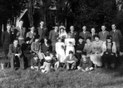
Left – Thomas & Ellen Farrell. Centre - Patricinne Joseph Hoshie Farrell. Right - Wedding
On 15th July 1896, in its report on their engagement, the San Francisco Call reported that Pat “had lately been commissioned by Gov. Budd as Surgeon of the First Infantry NGC” (National Guard of California). More than likely, this was an honorary appointment, given that he was so active within the Frisco medical community. The article went on to say that he “was a member of many prominent clubs”. Anyway, Pat went to Duluth in September for his wedding, where the tall, handsome, talented physician and leading figure in San Francisco ‘Society’ was treated like royalty, then returned to Frisco with Edna, travelling part of the way in her father’s private railroad car, via Yellowstone Park and other places of interest. Too good to be true? Seemingly not, but a John Crossman note in his family tree must have had some foundation – “He told some whoopers!”
For the next two years Pat and Edna presumably attempted to settle down in California, because in addition to his role at the University, Pat was supposedly appointed Adjunct Professor at the College of Physicians & Surgeons, San Francisco. Two children were born there during that period, Walter in 1897 and Helen in 1898. But then came the Spanish-American War.
According to a passport application that was to be submitted by Pat in 1920, he became a naturalised American citizen on April 30th 1898 (The same form indicated that he had emigrated from Australia in 1899 (Presumably he meant 1889, the year he first entered the USA from Alaska); that he had been born in England (Incorrect); his father in Ireland (Correct).
On Thursday June 2nd 1898 the following report appeared in a Honolulu, Hawaii publication, where the war fleet heading for the Phillipines had called for bunkers and to take on supplies. The reporter summarised personal details of the officers travelling on the troopships, including:
“Dr P J H Farrell is an Irish Britisher whose brother is a knight of Victoria’s Realm and Governor of Tasmania. He (Pat) took the Oath of Allegiance to the United States just before the vessels sailed”.
Tasmania’s Governor at the time was Jenico William Joseph Preston, 14th Viscount Gormanston, an Irish Peer and one has to wonder if Pat liked to mislead reporters just for fun, perhaps after a few drinks with his fellow officers? “Irish Britisher” carried a semblance of truth and seemingly Pat had been obliged to become a US citizen before he could go war, but brother of a Viscount was a little far fetched! However, records show that during Gormanston’s period of office, a nephew of his, John Edward Joseph Farrell, 1st son of John Arthur Farrell of Moynalty, Gormanston, Co. Meath, was a council member and holder of several offices in Hamilton, a town near Hobart, Tasmania! After his father died in 1904, John Edward returned to Moynalty as “Lord of the Manor”.
Is this perhaps a clue as to why Pat chose “Joseph” as his alternative second name, because he learned that the Preston and Farrell families of Gormanston used Joseph as a second or third name extensively for their boys over several generations? Could Pat have been pulling the Hawaii reporter’s leg a little, yet was correct in saying that he had a brother holding office in Tasmania? In which case his father was John Arthur Farrell, pillar of Irish society, not Thomas the Convict?
Anyway, Pat did go to war (yet again!) and according to the ‘Goulborn (NSW, Australia) Evening Penny Post’ dated 2nd December 1899 Pat wrote a letter to his father Thomas dated 31st October in which he described some of his experiences. Apparently he had remained in the Philippines for 16 months (Not 7 months per his 1920 passport application), during which time he had been wounded twice, not seriously and received two medals for gallantry under fire which according to a Frisco newspaper had happened when he was tending to wounded soldiers.
Back in Frisco Pat was possibly preparing to go to China to serve in the relief of the Boxer siege of the foreign embassies. The previously referred biography stated that Pat was a veteran of the “Spanish – American – Philippines - China Wars (Commander in Chief) although on 2nd June 1900 he was at home in Frisco for the Census, which recorded England as his place of birth, also that of his parents. However since the deciding battle between an Allied Force and the Boxers did not take place until August, it is possible that Pat was present, not however in command! Apparently after the battle, looting was rife and he took home a lot of items!
By the next year, Pat had been appointed Professor & Head of Department at the Chicago College of Medicine & Surgery and the family moved to Chicago where son Jerome was born later that year, daughter Louise two years later.
Shortly after settling in Chicago, at 443 Elm Street, Pat was involved in the very serious 1902 Litchfield train smash, in which there were many casualties. Pat was credited with leading the rescue efforts, despite having been thrown the length of the observation car, where he had been sitting.
On Feb 7th 1905 a Civil War Pension Index, General Index 1861-1934 lists a file from Illinois for PJH Farrell as Capt Assistant Surgeon Californian Infantry, Capt & Lt Col. Medical Dept USA. Classification ‘Invalids’. Obviously Pat was not an invalid in the true sense of the word, because he was still very active and later photos show no signs of disfigurement, but of course his injuries might have been to his leg(s) in which case a limp or difficulty in walking could, in military jargon, have classed Pat as an invalid.
In Chicago, the 1910 US Census recorded Pat as having been born ‘India English’, that he had immigrated in 1889, had become a naturalised citizen and was employed as a physician & oculist. As in 1900 both his parents were recorded as having been born in England. Given that the 1900 census had him being born in England, Pat’s use of the words “India English”, assuming that is how he described himself to the census taker, in 1910, is very interesting, particularly since he had told someone years before that India had been his birthplace, subsequently changing to ‘England’, now ‘India English’!
If we try to “see the wood from the trees” it would be easy to conclude that Pat had indeed been born in India but had been registered by his father as English, as would have been possible then, as now, for British expatriates, including members of the Army. Otherwise the census taker might have confused ‘India English’ with ‘Anglo Indian’ ie the child of an English father and Indian mother, or vice versa.
Pat’s job at the Chicago College of Medicine & Surgery ended in 1915 and in 1916 he became Professor of Military Medical Hygiene. Presumably Pat was employed by the Army in a peacetime capacity but on April 17th 1917 the USA declared war on Germany and in all probability he either volunteered to serve again, or was ‘called up’. Various publications make much of his WWI record but in reality he did not spend much time in France, only setting sail from Hoboken NJ on the 31st August 1918 with the US Army Base Hospital No. 81 on board the SS Leviathan, listed as Major PJH Farrell of 514 Belmont Avenue, Chicago. According to an Australian history web-site, “When the USA entered the Great War, General Farrell went with his Division to France. He was in command of the Meusse-Argonne section of all hospitals and medical work of the American Army. At the end of the war, he was the Commanding Officer of the Advance Sector Hospitals in France.” The war ended in November, two months after Pat’s arrival and he was back home by June 1919, a total of 7 months in the field! His biggest problem was likely to have been the ‘flu pandemic that swept the world in 1918
.
In January 1920 another census was held, the Farrells being still in Chicago, with Pat’s details a little different to 1910, being Patrick, not Patricinne, and his place of birth simply India, with English as his mother tongue. Then in March, as referenced previously, Pat applied for a passport for both he and Edna to visit his son Walter, who was with the US Marines in Haiti. In the application he “solemnly swore” that he had been “born in England and that he “had emigrated to the USA in about 1899, sailing from Australia”!
A New York passenger list for the SS General George Goethals arriving 10th May 1920 included a Patrick J Farrell, accompanied by Edna Farrell, returning from Haiti, the former born 17th March 1863 in Calcutta, India!
In Feb 1923 Pat again obtained a passport for himself & Edna, the 1920 issue having been cancelled for some reason. In the application Pat declared that he had been born in Essex, England; that father Thomas Farrell had been born in Ireland; that he had emigrated to the USA about 1888 from Australia; that he had resided for 35 years uninterrupted in USA Cal & Ill. from 1888 to 1923 (Didn’t go to Chile then?); that he had been naturalised in 1898: and that he had served in Philippines with the US Army from June 1898 to Jan 1899, in France Sept 1918- June 1919, and in Haiti April 1920-May 1920 (Actually visited Walter, but was maybe still in uniform). On 14th April 1924 the Farrells returned from their second visit to Haiti, aboard the SS Flora, Pat giving his birthplace on the passenger list as India, recently Colonel, Medical Corps US Army.
At face value, Pat could have been prosecuted several times for providing false information in census returns and passport applications, but clerical errors or sheer laziness on the part of the officials involved have to be taken into account, but there is a big difference between being born in Essex, England, as opposed to Calcutta, India, particularly since he was supposed to have been born in Braidwood, Australia!
Clearly, Pat deliberately misled officials on several occasions, but why should he have done so? Did he have psychological problems? Did he suffer from the ‘Walter Mitty’ syndrome (An ordinary often ineffectual person who indulges in fantastic daydreams of personal triumphs")? Was he simply being mischievous? Did he have something to hide about his past? Or had he discovered somehow that he had not been born in Australia and that in fact England or India were possibilities? Seemingly the latter, because he stuck with India for both the 1930* and 1940 Censuses! (*For the 1930 census, still living in Chicago, Patric J H Farrell gave his birthplace again as India and that of his parents as England. Strangely his wife’s name was given as ‘Page’)
During the 1930s & 40s Pat was the subject of several newspaper mentions and featured once more in a US census:
• On 10th November 1936, in Los Angeles, it was reported that “eight divisions of marching men & women would be led up Broadway by the Grand-Marshall, Brigadier General P J H Farrell & his staff to form the most brilliant & spectacular Armistice Day parade in recent years”.
• On 12th January 1937, in Los Angeles, an interviewer reported that ‘General’ Patrick H Farrell had a huge sabre scar on his temple (Not visible in photos!), a warped arm and plenty of other wound scars on his body (Presumably the reporter had to rely on Pat’s word!). He was a soldier of fortune in South America and South Africa and an adventurer in Alaska. He was both a brigadier general (Pat was a major in WW1 and supposedly a colonel in 1923) and surgeon general. He was born into the army (An implication that his father had been an army man?) and started his career as a cavalryman (Aged 16 in Zululand?) but when one of his wounds laid him out for a long time he took up medicine (Liverpool NSW?).
• On January 2nd 1940, in Sacramento, California, it was reported that Adjutant General P J H Farrell, state commander of the National Guard, would review troops engaged in annual manoeuvres.
• The April 1940 census had Edna and Patrick (born in India) living in a Sacramento hotel, separately listed, with his occupation being ‘Adjutant General’, National ‘Guard’, having achieved 4th year college, yet in September 1946 an LA social tit-bit reported that “General & Mrs Patrick J H Farrell of 530 Sth Kingsley Drive (a very grand address) had celebrated their golden wedding anniversary with a Dinner for family”.
In the process of building Pat’s story in his family tree, John C. came across several mentions each of his rank as “Surgeon General”, “General”, “Brigadier General, Cavalry” and Adjutant General, but given the fact that his entire military career was devoted to medicine, there has to be doubt he was ever a ‘General Officer’ in Army terms, particularly as a cavalry commander? When Pat arrived in France he was a major and might have been promoted to colonel during his nine months service there, but quite how and where he could have been promoted further is not apparent. However, the Adjutant General of a state is de facto commander of a state's military forces, including the National Guard and in some states it is a political appointment, very prestigious and no doubt deserving of being addressed as ‘General’ socially.
Patricinne/Patrick J H Farrell died 11 Dec 1956 aged 93, in LA, and was laid to rest by Edna and daughter Judith Louise at Forest Lawn, Glendale, California
So that’s that then! Cousin John Crossman basically got his grandfather’s story right but warned his family that they should take a ‘few grains of salt’ with respect to some of his apparent claims. All I have done is check his timeline against historical facts and confirm that he could at least have been where he said he was at the time, if that makes any sense! But since then I have found documents that do not appear to have been included in John’s Ancestry.com ‘Gallery’ for Pat, in particular a form filled out, seemingly by Pat in 1902, presumably in his own handwriting, at home in Chicago, as a member’s personal record for the US Association of Military Surgeons. If real, it contains information that either significantly changes or confuses what we have been led to believe so far, or demonstrates that Pat simply fabricated lies, as and when convenient to meet his objectives! Some of the stand-out points:
• Place and Date of Birth – Essex, England, 1864. (Strange he should get the year wrong!)
• Name of Father – Thomas Hoshie(!) Farrell
• Name of Mother – Louise Ellen Gormanston! (Not Ellen Connell then?)
• General Education – Public Schools, India and England! (Not Braidwood then?)
• Colleges – St Bedes and Sandhurst Military Academies!! (St Bedes in Manchester is not a military academy. BUT St Bedes in Braidwood is the Catholic Church!)
• Non-professional positions – None. Served in 6 armies and wounded 8 times. (What about cane cutting or gold prospecting?)
• Previous Military Grades - 2nd Lieut Cavalry 1883 (In Queensland aged 20?) - 1st Lieut Cavalry 1885 British Service (Sudan aged 22?)
• Active Service – India 1884* – Guatemala-Salvador! – Chilean Revolution, Colonel commanding regiment!
*The Afridi Wars, India – A series of clashes over decades near the NW Frontier with Afghanistan, not a continuous war as such.
However, in fairness, there is always the possibility that someone else was delegated to fill out this form, but at the bottom of the first page, the phrase “all my life”, strongly suggested that he did so personally.
Well, I had just about reached the point with Pat’s story where I felt that an attempt to make sense of it all might be amusing but decided to take another look at “Louise Ellen Gormanston”, by turning to Family Search for a change. And found Pat’s death certificate, issued at the Veterans Administration Hospital, Los Angeles on 14th December 1956, giving his date of birth as 18 March 1863, in England, and his parents as being G. T. Farrell and Ellen Louise Gormanston, both born in Ireland!
So how would Pat be aware of the Gormanstons? Well, possibly because Irish peer Lord Gormanston and family had travelled through Australia in 1893 en route to Tasmania and his Lordship (common name ‘Jenico William Joseph Preston’), had become Governor of Tasmania from 1893 to 1900. Indeed, as described previously, Pat claimed in an interview with a Hawaiian newspaper that his brother was said governor! Furthermore, Gormanston had been an Army Lieutenant in India during the Mutiny of 1857-88 and had a sister “Hon. Lucretia Pauline Mary Preston”, born circa 1839, who married a John Arthur Farrell of Moynalty House, Meath (a very big cheese with other homes in Dublin, Bray, and Killiney) and had eight children. For a moment I thought that the truth as to Pat’s origins was about to be revealed, but none of J A Farrell’s offspring were named “Patrick John” or “Patricinne Joseph Hoshie”! However, their 6 sons all had ‘Joseph’ as a middle name! All coincidental perhaps, but the question remains, how come the name ‘Gormanston’ appears on as important a legal document as Pat’s death certificate?
Thus another somewhat perplexing contradiction has been added to Pat Farrell’s story, ironically at the very end of his life. But let’s go back to the beginning and see if we can hypothesize the truth, based on such ‘facts’ as can be relied on, or not, as may be the case!
Thomas was an extremely common given name in Ireland during the 19th century, as was the surname Farrell, and with people quite commonly having families of 10 or more children, there were an awful lot of Thomas Farrells coming into the world in those times. Furthermore, over the years quite a few of same got into trouble and were transported to Australia for their sins! There is no certainty, therefore, that the ‘Thomas Farrell’, who arrived on the good ship ‘Dunvegan Castle’, was the one who became the father of all the Braidwood Farrells, particularly since the Thomas who was arrested for pickpocketing in Dublin and who supposedly had Dublin-born parents, was unlikely to have been a Limerick boy. Indeed, for me to have DNA matches with Braidwood links, it is more likely that Thomas Farrell of Braidwood was born in Dublin.
It is not a foregone conclusion, either, that the convict Thomas Farrell of Braidwood had necessarily arrived from Ireland, because New South Wales was a regular destination for members of the Indian Army who had been found guilty of misdemeanours and kicked out as a result. Furthermore, the records show that during the early 19th century many Thomas Farrells were born into Indian military families!
Then there is the mystery of Pat’s supposed birth in Braidwood on 18th March 1863, registered simply as “Farrell”! All of the children born previous to Pat, and thereafter, were registered with their full names, so why not Pat? The fact is that no firm evidence exists as to where, when, or by whom Pat Farrell was born into this world or, for certain, who his father was! Indeed, he could have been born elsewhere in Australia, or in another country, on a different date and to different parents, then taken to Braidwood at a young age where a birth ‘registration’ had been arranged by Thomas and Ellen, pending de facto adoption!
It is worth noting here that although my DNA link to Thomas via the Braidwood ‘Cooks’ might be entirely possible, my DNA link to John Crossman and thereby separately to Pat, might also be possible, via a different Farrell branch. For example, if Pat’s real father was one of Thomas’s cousins, we would still all share Farrell DNA in some degree or other.
Pat’s early memories, as with all children, would have been mostly about growing up in a large family, in a rough and ready Australian rural community, probably going to a local school and church at the weekend. He would have been aware that his ‘mother’s rellies were a bit of a problem, but otherwise his family’s origins would have been of no interest whatsoever. As already suggested, his closest sister Margaret was probably his best ‘friend’ and as for Pat, Braidwood would have been her ‘world’. However, if there was anything ‘unusual’ about his origins, his considerably older siblings would likely have known about them and ultimately Thomas would have been obliged to tell Pat, if only to forestall him finding out from others.
When John Crossman was undertaking research for his family tree, he recorded three ‘Mytags’ about his grandfather’s life.
• The first suggested that “Patrick was sent to Europe to study medicine and his published biography states that he was a Lt.,Capt.,in the Egyptian, Soudan & Afendi Wars, 1883-1886; Col. Brig. Gen. Chilean War, 1889-90; Capt. Spanish-American and Philippine Wars; etc etc” a series of almost unbelievable claims to fame!
• The second tag toned down Pat’s claims somewhat, suggesting that John had recognized a few exaggerations, beginning “After further review, I think that Granddad enlisted in the Army around 1877 and saw action in the Afendi campaign in 1878 in India. He went to England and with the Zulu was in South Africa in 1880. Etc etc”
• And finally, in a very different assessment, John began: ”In June 1878 at the age of 15, the young Patrick left Braidwood and went to the cane cutting state of Queensland”……By this time John clearly didn’t know what to believe!
In the 19th century, boys in poor families were invariably sent out to work at a very young age compared to today, education having been pretty basic. That Pat would have been employed by a Braidwood business, or farm, or even by Thomas, was to be expected, but to head off to Queensland at that age, possibly to work in the gold, or cane fields would have been unusual, either being extremely hard work. In Pat’s case, being told that he wasn’t who he thought he was, might have shocked him into leaving home suddenly, or maybe there were stories in the newspapers telling of the big money that was there to be made. Anyway, he went and seemingly was away for 2 or 3 years, during which time he could have made it to South Africa and back.
Following a return to Queensland with his sister, Margaret, a short period of stability followed, until he joined the expedition to the Sudan, was wounded and repatriated to Sydney, where he was to spend the next 18 months at that city’s Liverpool Hospital. Thereafter he probably moved on to Alaska, followed by California, Chile, back to the USA and to Kentucky for his medical studies. There it was that he made the first* of many claims, in providing personal information for official documents, to having been born in India!
Up to this point, there don’t seem to be any records of his early entries to Alaska, the USA, or to Chile, in order to determine which country he gave as his place of birth on those occasions, although in a 1920 passport application he did indicate that he had first travelled to the USA from Australia. So why India? A number of reasons are possible, including:
• He had discovered that he had indeed been born in India. OR
• He was ashamed of being identified with Australia. OR
• He needed to hide the Australian connection for some reason. OR
• He needed to hide his tracks in the USA thereafter as much as possible.
For the rest of his life Pat continued, on occasion, to declare India as his home country, sometimes adding Calcutta as his city of birth, but on other occasions it would be England, and even Essex, England. But never, it seems, did he give Braidwood, Australia as his home town! Did it never occur to him that by giving false information for official documents he was risking prosecution? Surely he didn’t just forget!!
Then there was the matter of his name(s). Generally he became known as ‘Patricinne’ but still used ‘Patrick’ from time to time, suggesting that he personally dreamed up the former in order to enhance his image in society, the latter being a very ‘common’ name, automatically associated with Irish immigrants! ‘Joseph’ as opposed to ‘John’ would seem to have been unnecessary for image building purposes, but could have resulted from the discovery of a link with the Gormanstons! Calling himself ‘Hoshie’ can only have been due to an Indian relationship of some nature, either family or friend, or maybe a nickname used for him by fellow workers in the cane fields, many of whom would have been Indians!.
In conclusion, let’s review Pat’s seemingly amazing life, from Australian ‘bush boy’ to renowned American soldier/surgeon, to see if the research undertaken reveals the truth as to his origins, by considering several possibilities:
The easy answer, of course, is to conclude that Convict Thomas and wife Ellen were his real parents and that Pat was simply a brilliant and adventurous individual, with a vivid imagination, who realised at an early age that with the aid of a little ‘bullshit’ and economy with the truth, he could get to the top of whatever profession he chose.
Alternatively, Pat’s father was an Irish soldier in the Indian Army, a Farrell relative of Thomas’s, whose circumstances led to Pat being taken to Australia and ‘adopted’ by Thomas and Ellen.
Or, during his service in India (late 1850s) Lord Gormanston had a dalliance with the daughter of an Indian Army Farrell, a relative of Thomas’s, the result of which was Pat (b. 1863), and to cover up for Gormanston, arrangements were made for Pat to be adopted by Thomas, with a financial arrangement that later paid for Pat’s education and travels overseas!
Or, Lord Gormanston’s father, the 13th Viscount, had a late life affair with a Farrell lady in Ireland and Pat was born as a result. In order to hush up the affair Pat was shipped out to the care of Thomas and Ellen. This would explain why Pat referred to “his brother, the Governor of Tasmania”, when in Hawaii.
Or any computation of the above!
But what do you think?